Written by the Milistuff editorial team – anaesthesiologists and CPR instructors. This text is not legal advice; always check what applies to your organisation and to the country you drive in.
You are often first on the scene. That applies to those who patrol, those who drive to and from the hunting grounds and those who commute on country roads every day. So the question is not whether you will need first aid in the car, but what you will have to work with when it happens.
What the law requires – it depends on the country
There is no single European rule on first aid equipment in private cars. Each country decides for itself, and the requirements differ considerably. A few examples we have checked against the legislation:
- Germany: motor vehicles must carry first aid material that meets at least the DIN 13164 standard (StVZO § 35h). Motorcycles are among the exceptions.
- Sweden: there is no requirement for a first aid kit in a private car. Neither the Swedish Road Traffic Ordinance (1998:1276) nor the Vehicle Ordinance (2009:211) contains such a requirement.
- Denmark: the Danish executive order on detailed rules for the construction, equipment and use of vehicles (no. 1484 of 3 December 2025) contains no requirement for first aid equipment in a passenger car.
- Finland: the Finnish Vehicle Act (82/2021) requires a warning triangle but no first aid kit.
These are examples, not a complete list. Check what applies in your own country with the national transport authority or a motoring organisation, and check again before driving abroad – whether a requirement also applies to a foreign-registered car depends on the rules of the country you are visiting. A first aid kit in the car settles the question whatever the answer.
That the law does not require it does not mean it is unimportant. It only means that the responsibility is yours.
When the car is a workplace
If the car is a work tool – a patrol car, a service vehicle, a vehicle in the fire and rescue services or in the security industry – occupational health and safety rules apply. In the EU, the Framework Directive on safety and health at work (89/391/EEC) requires employers to take the necessary measures for first aid. Each country implements this in its own legislation, and the details differ.
As a rule, those rules do not contain a packing list for vehicles. It is the risk assessment that decides what should be carried. A guard working alone at night faces different risks than a salesperson in the city centre, and the equipment in the car should reflect that.
What the car should actually carry
A car makes it possible to carry more than you can on your body. Divide the equipment into two parts: one for everyday injuries and one for life-threatening injuries.
Everyday injuries – the first aid box
- Sterile dressings and compresses in a few sizes, for example quick dressings for smaller wounds. More are available under Dressings.
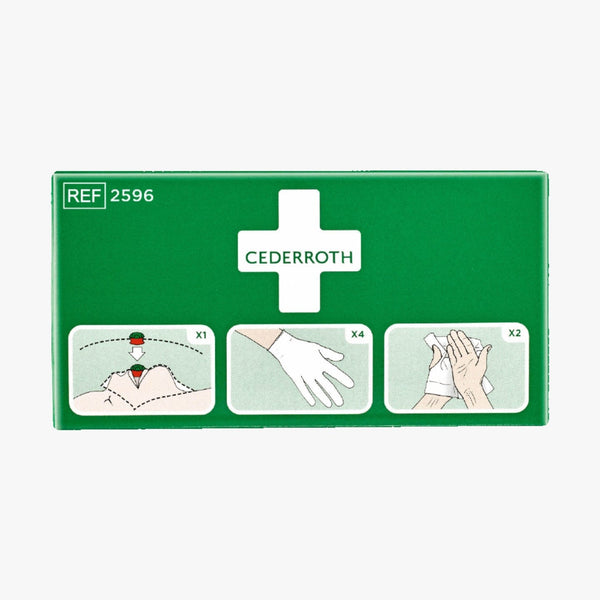
- Protective equipment: disposable gloves and a face shield for rescue breaths during CPR, for example the Cederroth protection pack, which combines a mask, gloves and wound cleansing.
- Burn dressings. For a burn, water is the first choice for cooling. A burn dressing with gel is a complement when water is not available, or to protect the injury afterwards. More options are under Burn dressings.
Life-threatening injuries – what is often missing
Many ready-made car first aid kits are built for minor injuries. What saves lives in a traffic accident or a hunting accident is bleeding control and warmth:
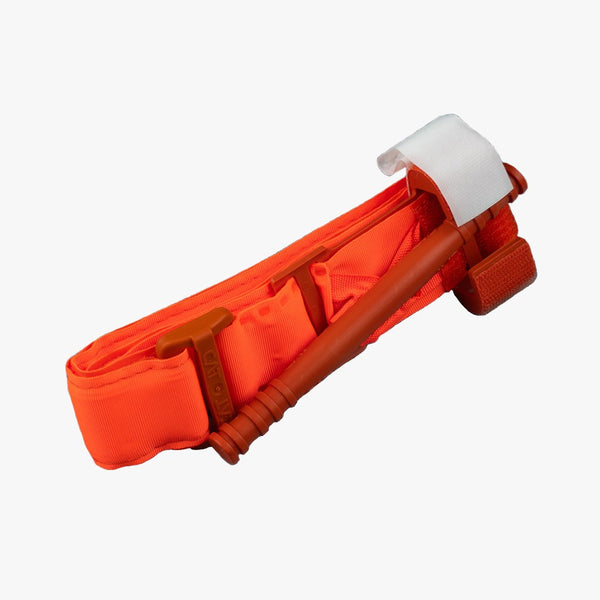
- Tourniquet. An orange CAT Gen 7 is quickly spotted in a boot. Read our tourniquet guide before choosing a model.
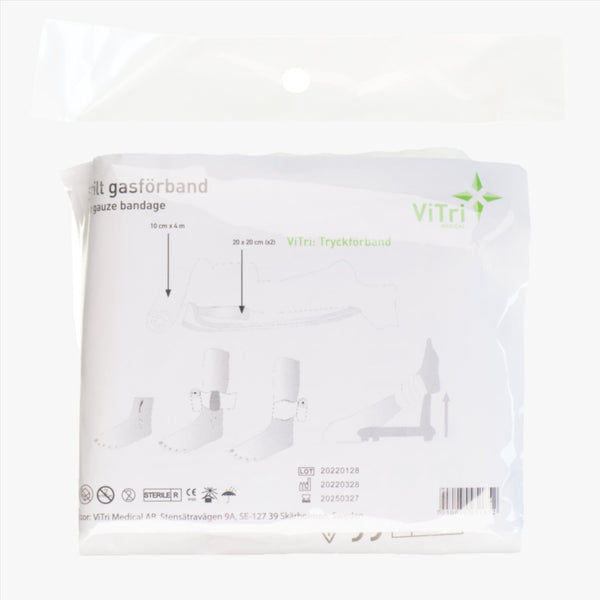
- Pressure bandage that holds the pressure when you need your hands for something else, for example a pressure bandage or Control Wrap 6".
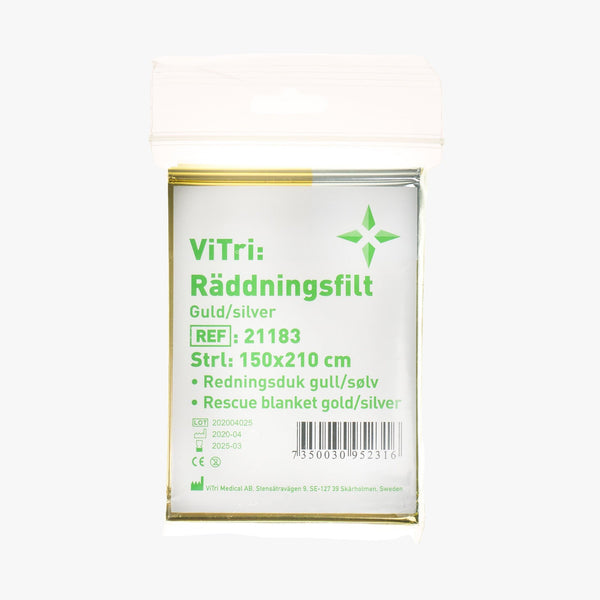
- Warmth. A casualty lying still on asphalt or in a ditch cools down quickly, even on a summer evening. Pack a rescue blanket, or a self-heating blanket if you drive a lot in remote areas. More are under Hypothermia. Also insulate against the ground.
If you already carry a personal kit on duty, see our guide on what goes in a first aid kit. The car's equipment is a complement, not a replacement.
Storage in the car
- Reachable, not buried. The first aid box should be accessible without emptying the boot. Bleeding control should be reachable from the driver's seat.
- Secured. Loose equipment becomes a projectile in a crash.
- Temperature. A car can get both hotter and colder than the manufacturer's storage range. Read the storage instructions on the packaging, and replace products that have been kept outside it.
- Checks. Go through the contents regularly: expiry dates, intact packaging and that anything used has been replaced.
Sources
- StVZO § 35h Erste-Hilfe-Material in Kraftfahrzeugen (in German)
- Swedish Road Traffic Ordinance (1998:1276) (in Swedish)
- Swedish Vehicle Ordinance (2009:211) (in Swedish)
- Danish executive order no. 1484 of 3 December 2025 on detailed rules for vehicles (in Danish)
- Finnish Vehicle Act 82/2021 (in Finnish)
- EU-OSHA: The OSH Framework Directive 89/391/EEC
- European Resuscitation Council Guidelines 2025 First Aid